I wanna be digital

Joe Konrath’s recent post, Digital Me, focuses on our collective love affair with home entertainment and its conversion to digital media. In particular, he talks about replacing much of his vast book collection with digital versions. I confess, ever since I bought my iPad, I’ve had urges to do the same.

Several hundred books collect dust on bookshelves throughout our house. I keep them  because I might want to read them again. Some day. Or because my daughters/husband may want to read them. Some day. In some cases, I keep them on hand only so I can steal the authors’ writing techniques.

Some of these books have not been opened in 10 years or more. Even so, I’ve always felt  the need to keep them around. Just in case.

And then I bought my iPad. You can collect an awful lot of books on a 16 gig iPad and they take no significant space in your house. I can loan books to my family’s e-readers. If that doesn’t work, I can loan the iPad itself (some restrictions apply, so don’t get ideas, children).

My books used to be shelved alphabetically to help me find a title easily. But then I ran out of space. Now I’ve got volumes crammed two deep on the shelves, with paperbacks wedged into the gaps any way they’ll fit. I only know where the oldest ones are. That’s because I haven’t moved them in years and they are still in alphabetical order behind the jumble.

I think I can squeeze a few more books on there...

And then I bought my iPad. All the reader apps have some sort of easily-searched contents listing. You can find your book and start reading just by touching an entry in the card catalog.

I used to read for hours on weekends and in the evenings. But I’ve been slowing down recently. I grow impatient and bored more easily, setting books aside to watch bad TV. Where I used to slog through at least half of a weak book before giving up on it, I now sometimes quit after just a chapter or two, even though the book cost me $8-$15.  I figured I must be getting pickier with age, that maybe books aren’t as good as they used to be.

And then . . . I bought my iPad. Yes, I still wince at typos and clumsy writing. But I have finished more novels in a shorter time during the few weeks since I got my iPad than I read the whole previous year on paper. Turns out, the source of my impatience was eyestrain. The words on the printed page fade and blur when I try to read, with or without my glasses (which I usually can’t find, anyway). So I get tired of reading quickly. With the iPad, I can adjust font size and brightness to read comfortably for hours.

This post is not meant to be an ad for iPads. You could easily replace “iPad” with “color Nook,” or maybe “Kindle.” The point is, my e-reader has made my reading life easier and better.

So, sometime soon, I’ll be going through all of my books, getting rid of the ones I’ve always secretly known I’ll never read again (or, in some cases, never read for the first time). If I change my mind later, I can always download an e-book version that will last forever and never get dusty. Same with books I refer to often—why not have them all in one handy place?

I’ll still keep some physical books—the ones with sentimental value, that I’ve carried with me since childhood, full of my chocolate stains and dead ants from when I used to read in the fort I built under the sumac bushes. And I’ll keep any books signed by the author, if only because I never want that author to find his/her signed book in a used bookstore, like he/she no longer matters.

The transition has already begun. Already, I feel guilty if I buy a physical book, like I’m some kind of dust-collecting, resource-sucking tree murderer. The only thing stopping me from complete and immediate conversion is that sometimes the e-book costs more than the paper book.

But I predict that soon 100% of the books I buy for myself will be digital. Well, maybe 97%. Old habits . . .

Posted in Books, Life, Writing | Tagged , , , , , | 12 Comments

Train Trip, Part IV: FAQs, Tips, and final thoughts

Now that I am a veteran train traveler (having ridden the train twice—there and back again), I thought I’d answer some questions that people have thrown my way.

(1) What’s it like to sleep on a train?

There are two ways one can sleep on the train (not including heavy sedation). You can pay roughly the same price (or less) as you would have spent on airfare to ride in coach. (That’s if you’re on U.S. Amtrak. Fares are considerably higher on Canadian trains.) In coach, you would spend the night on a reclining chair in the company of your 50 new best friends. Or you can pay an extra $350 to $1000 to get a sleeper car. (That’s divided among the occupants of the car, not per person. And it includes meals. And it assumes you’re starting in Seattle and finishing in Detroit Lakes, Minnesota.)

I can’t speak for the sleeping conditions in the sleeper cars, but I couldn’t believe how well other people slept in coach. I awoke several times a night to find only a handful of people moving around. Everyone else seemed to be out cold. (Tip: bring blanket and neck pillow.  Regular pillows are supplied.)

I was also amazed at how few people snored during the night. All sorts of people ride the train—young, old, male, female, thin, chunky—you’d think there’d be at least one monster snorer in the bunch. Of course, a monster snorer might be among those who couldn’t sleep well, and thus never reached their full decibel levels.

Hmmm. . . maybe I was the monster snorer . . .

Nah, Jules would have said something.

(2) What’s the food like?

On our train, the lower level of the observation car included a snack bar where you could buy coffee, bottled juice/water, and assorted packaged snacks. They also had a breakfast sandwich (I never saw what that looked like) and hamburgers. Jules and I ordered the hamburgers one night when we couldn’t get a dining car reservation until after 9:00pm. The attendant pulled a couple of plastic wrapped packages from under the counter, tossed them in a souped-up microwave and whamo! Dinner in 15 seconds. The beef patty was thick and wide and the color of aged asphalt. The cheese had vaporized and reformed as a thin coating around the interior of the plastic wrap. The taste of the ensemble was adequate, if you didn’t think about it too hard. Ditto for the price.

We ate the rest of our meals in the dining car or nibbled on some granola we brought along. The dining car was like a restaurant. You make a reservation and either go at a preset time or go when they call your name. The upper deck is lined with tables covered in white cloth. A waiter seats you, gives you a menu, and takes your order. The food is prepared in a kitchenette on the lower level and sent up to the dining area via dumb waiter.  (The dumb waiter made my older daughter, Hannah*, extremely happy.  She wants one installed in her bedroom.) Dinner prices range roughly from $14-$24. Breakfast ranged from $8-$12. I don’t remember lunch prices.

During the course of our journey, I had braised beef ribs, roasted half of a chicken, French onion soup, and pancakes. The beef was actually pretty good. The roasted chicken was good in a reheated sort of way. Both dinners came with steamed veggies that had little flavor other than the plastic wrap they were steamed in. The soup was tasty for the first few slurps and then became tiresome—but that can happen with French onion soup. The pancakes were at least as good as your average restaurant pancakes.

As I said before, if there’s only two of you, the maître d’ will seat total strangers at your table. One couple that sat with Jules and me ordered hamburgers for lunch. The burgers arrived looking suspiciously asphalt-like, though they did come with the lettuce and tomato that our lounge car burgers lacked.

To summarize, the food quality was variable but edible. The prices were a little high, but not Disney World high. My recommendation:  Go ahead and eat in the dining car once or twice, but pack a small cooler with cheeses, condiments, fruit, and raw veggies. Bring crackers, rolls, and individual portions of cereal.

(3) What are the bathrooms like?

Short answer: A lot like airplane bathrooms.

The bathrooms (or, if you prefer, washrooms/toilets) in our train were in the lower level of each passenger car.  There were at least 5 bathrooms per car.  Some bathrooms were roughly the same size as an airplane bathroom, but with higher ceilings. Others had changing areas attached, in case you spill coffee in your lap. As with all such public facilities, the ability to levitate and use mind powers to operate all fixtures is desirable.

(4) What are the seats like?

The seats in coach are reasonably comfy for riding and better than an airplane for sleeping. However, Amtrak is not a plush, well-funded operation. The foam in some seat cushions seems to have hardened with age and some foot and leg rests don’t work properly. Make sure to test all such functions before nestling in for the long term. Of course, if you don’t board at a hub, you may be stuck with the only remaining empty seats. In that case, be prepared to cherry pick as soon as someone departs.  (Tip: Do not steal anyone’s seat when they depart for dinner. Wait until you know they’re gone for good. Remember, they know where you sleep…)

Oh, and the stairwells are lit more brightly at night than the rest of the car, so maybe you don’t want to sit across from them.

(5) Can I recharge my laptop/cell phone/iPad/Kindle/electric toothbrush?

For all you electronics junkies, the answer is “yes.” Two outlets were available for every pair of seats on our train. But from what I read, not all routes have this luxury, so juice up before you go.  (But really, you’ll be too busy looking for antelope out the window and chatting with your NBFs to drain your toys dry, so there shouldn’t be an issue, either way.)

(6) What’s it like to travel on a train?

Our waiter told us that the train would go about 79mph, once we got out of the mountains. You’d think that the engineers would put in a little more effort and make it an even 80mph. Trains go through more and longer tunnels than cars do. One tunnel lasted 15 minutes. I think it was in the Cascades. We were told it was the second longest train tunnel in North America.

Passenger cars are fairly sound proof, so it’s easy to forget how loud they are from the outside. The train’s whistle (I would say “air horn,” but whistle is more romantic) sounds like it’s five miles away. Very atmospheric and nostalgic, unless your house is at a train crossing.

Much of the time, travel was smooth, with a constant, low-level vibration of wheels grinding on track.  Sometimes we hit stretches where the train rocked gently, side-to-side. I found both the low vibration and gentle rocking soothing. I actually slept better when the train was moving than when it idled at a station. Occasionally, we hit patches where the train rumbled and shook a bit, but nothing alarming. Sometimes the train jerked slightly, front-to-back, as if the driver had tapped on his brakes. This seemed to happen only at night, when I was mostly asleep, and I’d shoot awake thinking we had hit something.  (Who knows, maybe we had…)

One last thing—on a train, time and distance become confused. You get up to stretch your legs, grab some coffee in the lounge car, maybe sit at a table and play a few hands of cards. All the while, the miles roll by, mountains falling into foothills, crumbling away to dry prairie, and you’re in a new time zone. A few hours later, the train slows to thread through flooded wetlands. Flocks of migrating birds dash helter-skelter across the water’s surface, just a few feet from the window. And you’re in a new time zone. And distance becomes time becomes distance . . .

You sit back in your seat and meet your neighbor’s eyes.  “How far are you going?”

“I’m getting off in Grand Forks,” he says, and he checks his watch.  “About two hours away. You?”

“Detroit Lakes . . . maybe three hours further down the track.”

The train eases through a small town. Pedestrians stop to wave.  “Why do they do that,” you wonder, waving back.  But you know the answer.

They want to ride the train.


*Jules and I were by ourselves on the way to Minnesota, but all four of us made the return trip by train.

Posted in Life | Tagged , , , , , | 1 Comment

Marie Meets the Publishing Industry: Will writers be the next gatekeepers?

Joe Konrath and Blake Crouch have brainstormed a vision for the future of publishing that makes a lot of sense to me. In fact, my brain has been working along similar lines ever since I saw the possibilities of indie e-book publication, so I thought I’d put in my two cents.

First, I’ll summarize the concept for you using an example: Suppose I set up my website so I can sell my dark urban fantasy directly using Paypal. I would then make 100% off of sales on my book, after expenses.

Now suppose I put Cathy’s Celtic fantasy up for sale at my site, too, giving her a 70%-30% split on sales. This is obviously good for me, since I can make a bit of extra money with little extra effort. It also lets me provide more content to my readers, which may bring them back to my website more often.

But it’s also good for Cathy. Even though she’s only getting 70% of the profit, I am endorsing her work and exposing it to new readers.  If my readers buy her book through my site and like it, they may choose to buy directly from her website in the future (more $ for her in the long run). Further, Cathy could do the same for me—sell my book at her website with a 30-70 split on sales, thus providing a little income for her and more exposure (and income) for me.

Now suppose I do the same with five other writers.  Or ten.

It’s easy to see how authors could network this way to expand their exposure and support their writing careers. It’s also easy to see how helpful this could be to the readers (remember them?), if authors use reasonable care in choosing books to sell at their sites.

If you want to give this sort of networking a try, I would suggest starting slowly, adding one book at a time, working with people you know and trust. Selling other people’s work involves a certain amount of accounting, paperwork, and a potentially interesting tax situation. It will take time for you to find a good balance between protecting your own writing time and managing your bookstore.

And always remember that, as an indie author, you are trying to build your own brand in the readers’ eyes. Choosing what to sell from your site is part of building that brand, so be discerning.


Posted in Writing | Tagged , , , , , | 2 Comments

Train Trip, Part III (or “I wanna be uninhibited”)

Here’s a thing about trains:  You are forced to be at least a little friendly. For example, if two of you are sitting at a table for four in the dining car, you can expect the Maître d’ to place another pair of people with you. So if you’re traveling the full, Seattle-to-Chicago length of the Empire Builder route, you could share meals with as many as six or seven other pairs. Adding to that, if you’re traveling in coach, you might be seated next to the same people for close to two days (with no showers).  I don’t often have that much together-time with my own family.

You could avoid meeting anyone by spending the whole trip wired into electronics or with nose buried firmly in a book. Or you could embrace the experience and emerge at your final stop with twenty new Facebook friends.

Indeed, I think that’s half the point of taking the train—at least for some people.

Jules and I had barely stepped onto the bus that was to take us to the Seattle train station when we were adopted by a pair of friendly train-travel veterans heading for Chicago. I’ll call them George and Georgina.

George was a quiet, smiley fellow who might have been content to give us a nod in passing and nothing more. Georgina was something else. Large-voiced and jovial, she recounted past experiences with Amtrak, convincing us that a go-with-the flow mentality was best when things went wrong at the border. When the bus passed into Washington, she turned tourist guide, providing tips on places to visit along the route to Seattle: Fairhaven (near Bellingham) has trendy shops and a great indie bookstore. La Conner is another nice tourist town. Leavenworth is a good German town with lots of Bavarian stuff, and Mount Vernon is famous for tulips in the spring.  (When I began typing Georgina’s suggestions into my iPhone, she perked up and racked her brain for more.) Somewhere during our conversation, she offered us a deck of playing cards. She said she collects them at casinos and gives them away on train trips.

We parted ways with George and Georgina at the train station, where they got in line with the sleeper car passengers and we joined the queue for coach. But that’s not the last we saw of them.

During our early morning stop in Spokane, our trained picked up an observation car with a sightseer lounge on the upper deck. This is another place to make some Facebook friends. It’s also a place to find coffee, so Jules and I headed that way when we reluctantly gave up on sleep and admitted it was morning. Covered in windows, the sightseer lounge is full of tables and outward-facing seats. Not surprisingly, George and Georgina were already nested at one of the tables, so we sat at an adjacent table to enjoy the view. (We were traveling past Glacier Park that morning, arguably the most spectacular part of the trip.) The other seats slowly filled with all sorts of people, including retired couples, young families, and college students returning to school. There was even an Amish family (man, woman, and teenaged boy) sitting at a table next to George and Georgina.

After Georgina showed me her knitting project and let me enter the pattern into my iPad (I sound like a walking advertisement for Apple products, don’t I?), she decided things were too quiet and pulled out a deck of cards.  Soon she was doing card tricks for our amazement and teaching the tricks to Jules. After a bit, she switched to coin tricks (doing and teaching). The Amish family turned in their seats to watch her antics with stoic curiosity. Noticing their attention, Georgina turned to them and asked if they’d like to see the coin trick, too.

“Why, yes,” they murmured politely, and Georgina was off, teaching them a new trick. When she was finished, she said, “Say, does your religion allow you to play cards?

I winced at the blunt reference to their beliefs. I tend to err on the side of “none of my business,” when it comes to religion.  But, unfazed, the Amish father graciously murmured, “Well, yes, it does.”

So Georgina returned to her seat and pulled another deck of cards from her bag.  “Here, you can have these.”

As they politely accepted the deck, she bubbled, “I have lots of decks. I collect them from casinos.”

I mentally banged my head repeatedly on the table and waited for lightening to strike. But I then I realized someone was shuffling the deck. And next thing I knew, the Amish family was enjoying a quiet game of cards.

As we reached Glacier Park territory, more people entered the lounge, looking for a seat. Jules and I moved to George and Georgina’s table to make room. A thirty-something woman joined the Amish family, who welcomed her with a smile and struck up a conversation. Two older ladies took one side of our vacated table and dad with young twin boys sat across from them. Soon the lounge car filled with friendly conversation all around.

Would this have happened without Georgina’s card tricks? Or would we all have shelled up, talking only to those we already knew? I don’t know the answer to that.  I do know that I wouldn’t have worked too hard at mingling. And I also know that Georgina exited that train with a slew of new friends.

I’m kinda hoping she’ll be on the train for our return trip.

Posted in Life | Tagged , , , , , | 5 Comments

Train Ride, Part II (or “Ruminations on Space Age Foam Beds”)

I won’t lie to you.  You will not get your best night sleep ever when riding coach on a train. Our car quieted down starting around 9:30pm. I read in the dark (the glowing iPad is useful in this circumstance) while waiting for the two women behind us (the only people still talking) to shut the #@%@ up! (Pant pant.  Excuse me. I value my sleep.)

When I finished the book I was reading (“Alanna,” by Tamara Pierce—I’m trying to get a sense of YA fiction), I switched to an audible version of “Monster Hunters Vendetta,” by Larry Correia, on my iPhone.  I was asleep within 30 seconds, which is not intended as a slam on the novel, which was entertaining enough. I woke up after a bit, realized I’d missed a chunk of the story, and turned it off.

Naturally, I couldn’t get back to sleep after that. Without Owen Zastava Pitt to distract me, I became all too aware that the seat reclined at the perfect angle to send me on a slow slide toward the footrest. At the best of times, the footrest ended mid-calf, leaving my feet dangling off the end. Without occasional vigilance, I might find myself oozing off the end and onto the floor. I began to suspect that my feet would be asleep long before the rest of me.

Eventually, I found a position I could live with and dozed off for a bit, enjoying the gentle sway of the passenger car.  Around 1:00am, the train pulled into the station in Spokane, Washington. The sudden quiet and stillness was too much for me.  I woke up and, energized by my little power nap, wandered downstairs to inspect the washrooms. The door to the train was hanging wide open and people were lounging outside, enjoying a smoke and the night air (assuming you can do both of those at the same time).  I chatted with our car’s attendant and a passenger who was heading for Cleveland while we waited for the Portland train to arrive.  Our train would pick up a lounge car and a couple of passenger cars from the other train before heading east.  I waited a while, wanting to see the exchange, but the Portland train was running late, so I headed back to “bed” to try to sleep some more.  Apparently I managed to pass out — I didn’t feel a thing when the train was reconstructed.

Next thing I remember, it was getting light outside, giving me an excuse to get up for the day. I think I managed four or five hours, altogether.  That was enough, considering the novelty of the whole experience.

Posted in Life | Tagged , , , , , , | 6 Comments

Train Trip, Part I (or “I wanna be an Empire Builder”)

It’s 5:11pm.  Jules and I are off on our big adventure – crossing half the continent in a train.

The journey began at 12:30pm, when we boarded a Cantrail coach (bus) in Surrey. Less then ten minutes later, we hit our first—

Excuse me, but we’re currently skirting the Puget Sound, just a few feet from the water and it’s GORGEOUS!

Sorry. Ahem. AS I was saying, we hit our first hitch—the Canada-US border.  Apparently, we’d hit rush hour for tour buses and it looked we might be stuck in the border wait for a couple of hours. No big deal, you’d think.  After all, if we were in a hurry, we’d fly. But the train was leaving at 4:40pm, with or without us.  We sat for 20 minutes or so, pondering our possible fate. Then the bus driver announced that another Cantrail coach heading for the train station was finishing up with customs, almost ready to go.  The four of us who were trying to catch the #8 train jumped off our bus, cut to the front of the line in customs, and jumped on the other bus, just 5 minutes before it headed into the US.  Yes! (I pump my fist.)

The bus ride continued uneventfully until we hit stop-and-go traffic on the outskirts of Seattle (on a Saturday?!). The bus’s lurching starts and stops were not great for those with weak stomachs, but we persevered and arrived at the train station in serviceable shape, half an hour before the train was due to pull out of the station.

Unlike airports that require vast amounts of uninhabited land around the runways, the Seattle train station is wedged among buildings, deep in the most urban part of Seattle. It was hard to get a sense of the train station from the outside—

Oh, hey! We’re passing a cruise ship! Looks like a sideways skyscraper floating on the water.

As I was saying, I got a dim impression of brick on the outside, though that impression could be completely wrong.  Inside, the station was a weird mix of bus depot (dingy, yellow walls, florescent lights, and clumps of people sitting or standing around) and baroque cathedral (ornate, vaulted ceiling and ornate walls).

I hear the haunting sound of a train whistle off in the distance – oh, wait, that’s us!  Heh, heh.

Jules looking for Platform 9 and 3/4

After a half hour wait, we boarded the train, a double decker with passenger seating upstairs.

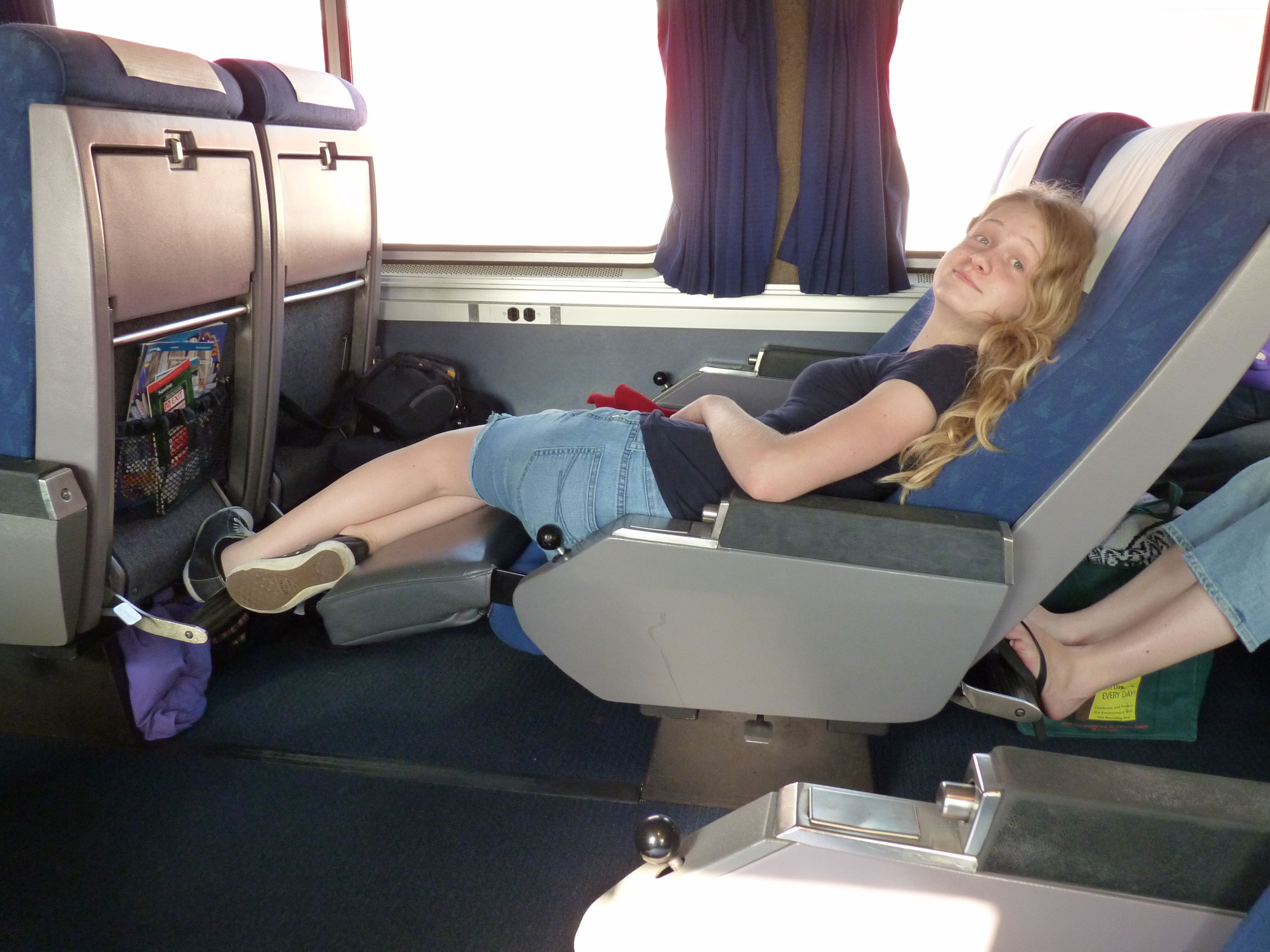
The train’s interior is not plush, but it is comfortable.  LOADS of leg room.  Delta would wedge another row of seats into the gap where our legs rested comfortably on adjustable leg rests.

Jules getting comfortable on the train

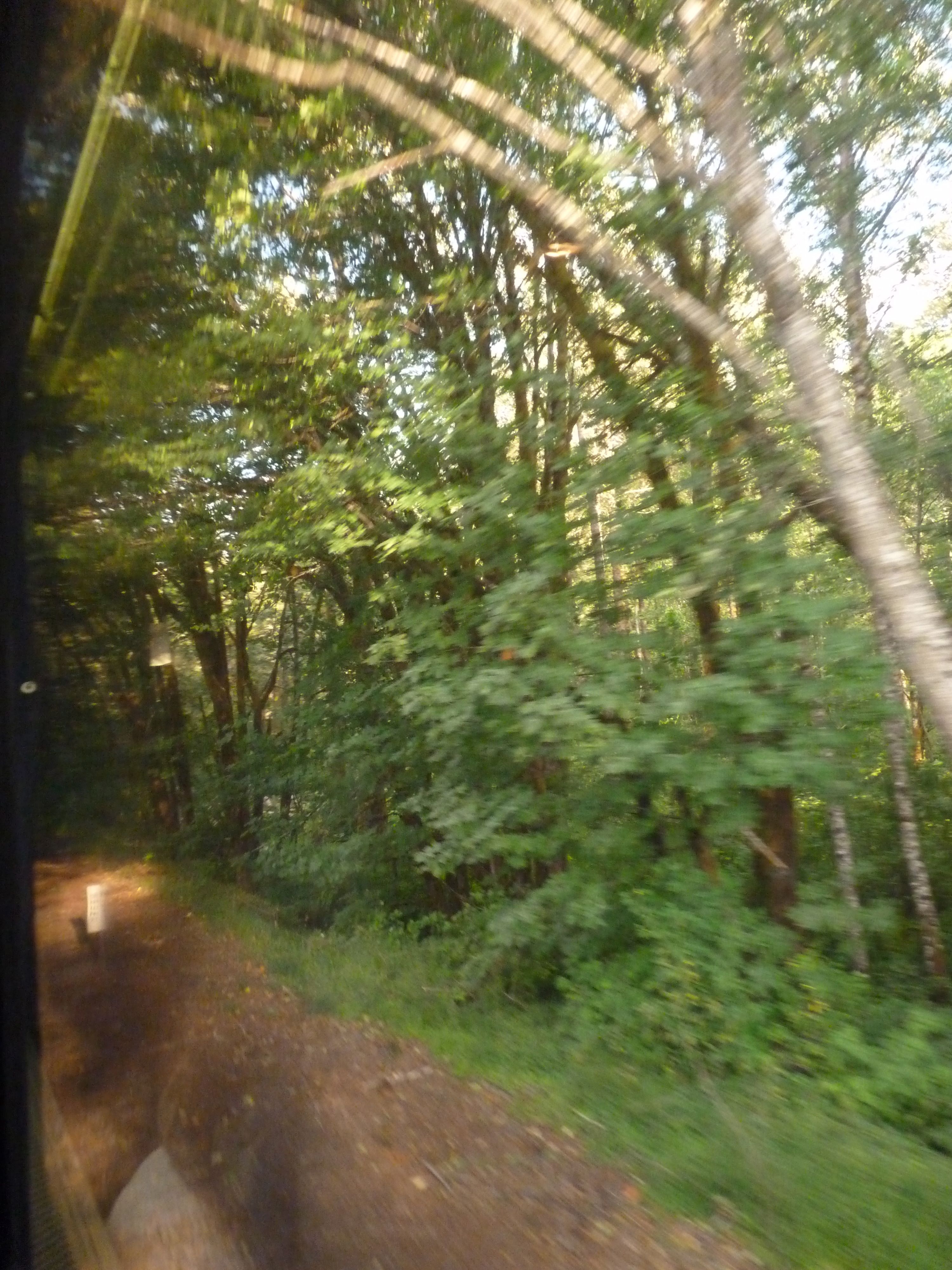
It’s taken me well over an hour to write this installment because the scenery keeps changing and I have to stop and look.  Right now, we’re in the Cascade Mountains of Washington.  I recommend them.  The mountains and winding river are incredible, and when you can’t see them it’s because you’re tunneling through dense forest. Here are some pictures.

Picture taken on a bridge

Hey, what do you want from me?  The train is moving!  (It might work better to take a movie, but I’m too cheap to pay WordPress for video upload.)

Tunneling through trees

I’ll continue with Part II of the train trip another day.  I know, I say that a lot, and Part II doesn’t seem to ever appear.  But it’s all just part of a larger plan.  Really!

Posted in Life | Tagged , , , | 7 Comments

Marie Meets the Publishing Industry: Do I really wanna be a writer?

This post is for fiction writers. But it’s also for fiction readers, because what happens in the publishing industry affects the availability, price, and quality of fiction.

In a recent post, I explained how I began my writing journey 18 years ago. It has not been an easy road.  Although I sold a couple of short stories fairly early and had a great time editing an online fiction magazine, the complications of a young family, day jobs, and multiple moves across international borders put my budding writing career on hold too often to gain any real momentum. The continual attacks of self-doubt didn’t help either.  Any discussion of the publishing process, e.g. the need to know the right people, to find the right niche, and to get an agent (really, the need to get an agent to help you find an agent) froze my brain worse than a slushy chugging contest. The only way I was able to finish my novel was to bury myself away from the publishing world and just write.

It worked.  I finished my novel. Finally. But when I poked my head out of my safe little cave, ready to expose my new baby to the world, I discovered the publishing industry had gone mad.  (Admittedly, it may have been mad before, but now it was mad in a whole new way.) I began to search the internet, trying to learn all I could to better my chances of publication, here is what I found.*

  • Agents are no longer obliged to respond to queries. Some still do, but apparently the volume of submissions has become so great that many agents can’t afford the time to send a form letter or single-sentence e-mailed rejection.  Or to figure out how to send an automated response, so that the writer at least knows the query has been received.
  • Agents are no longer obliged to respond to manuscripts sent at their request. Some still do, but I’m still waiting on 3 agents more than half a year after sending requested material.
  • At least one agent no longer feels obliged to respond to a manuscript revised to that agent’s specifications and resubmitted. (It’s been a year and counting since I sent that one out.)
  • It seems like publishers, and therefore agents, are more rigid than ever regarding departures from genre formula. The rise of the clones seems unstoppable. (My novel is an urban fantasy, but not a paranormal romance urban fantasy.  Good luck to me.)
  • In the face of the growing e-book industry and declining sales in traditional publishing, bookstore shelf space is shrinking and fewer titles are carried by bookstores.  Even best selling authors are being hit hard with this one.
  • From what I’ve read, most publishers are demanding 75% or more of e-book royalties, even though the cost of producing e-books is rather small relative to traditional publication.
  • Some publishers are experimenting with clauses in writers’ contracts, sometimes after the contracts have already been signed, usually to the detriment of the writers’ income and/or freedom.
  • The upheaval of the publishing industry is forcing agents to review their business models.  Some are responding by experimenting with agent-author contracts, usually to the detriment of the writers’ income and/or freedom. Some agents are adding “assisted self-publishing” services (for the same 15% commission), which creates a possible conflict of interest – will the agent continue to attempt to place a writer’s work with a publisher if she thinks she can make more money “assisting” the author to self-publish?

I knew it would be tough to get published.  I knew I’d be competing against a lot of good, hungry writers.  But it seems that contest is just a warm-up for the real war—the struggle to survive as a published author. That realization left me unable to write fiction for months.

But I still want to write.  And if I want to continue writing and want to find a readership for my stuff, I need to find a way out of this morass. In the next installment of “Marie Meets the Publishing Industry,” I’ll discuss what I think my options are, aside from total despair.

* If you want to read more about the changes in the publishing industry, start with The Passive Guy, who re-posts information on publishing-related issues gathered from blogs and articles around the internet and adds his own spin. He also dissects publishing contracts and agent relationships with the aim of protecting author’s rights. Through his blog, I found Authors Kristine Kathryn Rusch and Dean Wesley Smith, who discuss the business aspect of the industry from a writer’s perspective.

Posted in Writing | Tagged , , , , , , , , | 10 Comments

Animal Encounters

Each person in my family is famous (among ourselves) for some characteristic that sets them apart from the rest of us. For instance, Hannah is famous for being able to oversleep her alarm, sometimes by several hours. Tom is famous for breaking into endless streams of spontaneous haiku. I’m famous for my hair. And Jules is famous for her special way with animals. Oversleeping is boring, haiku is painful, and I’ve already talked about my hair, so today I’m going to tell you about another in a long line of animal encounters with Jules.

Last Sunday was brilliantly sunny and warm—a remarkable event in the Vancouver area. I had a free afternoon and was looking for entertainment, so I asked Jules if she wanted to go to the zoo. She accepted.

You know how you go to the zoo, and the animals are always hidden in the foliage or lying flat out, looking dead? Not so for Jules. The first time I took her to the zoo (she was two years old), it was like the animals’ Second Coming The bald eagles flapped their wings and shrieked at the sky. The monkeys launched themselves from branch to branch, calling out and throwing things at each other. The snow leopards prowled restlessly along the chain link fence. The otters gamboled along the glass walls of their enclosure, paralleling our progress as we passed by, and stopping to look at us when we stopped to look at them.

At the time, I attributed all this animal activity to the weather. A storm had just blown through, and the sun had broken through the last sprinkling of rain. But now I know better. The animals were excited because Jules was there.

The last time we went to the zoo, a little over a year ago, the cheetah fell in love with Jules. It followed her as she walked along its enclosure. When she stopped, it rubbed against the chain link, purring loudly. Yes, purring. I didn’t even know cheetahs could purr. We stayed by its enclosure for ten minutes or more, moving up and down the fence, while the cheetah played and ran circles, always returning to the spot closest to Jules.

Jules’ animal encounters aren’t always so positive. There was the time, when she was five, that she captured a bee with her bare hands. After all the shrieking and crying was over, her hiccupping, wounded response was, “B-but I wasn’t going to hurt it!”

And then there was the time she tried to pet the gyrfalcon. The scar has mostly healed.

But most of the time, Jules’ animal encounters are wonderful. Magical, even. So it was with much anticipation that we headed to the zoo.

The visit started a bit dull, at least by Jules’ standards. The lions and the lynx were hiding, though we did see the caracal, which had remained invisible in previous trips. Jules thought the collared peccaries were cute and wanted to hug them, but they held their distance. We did finally see the ever-elusive bull moose. (As big as they are, I had never managed to see one at a zoo. I think they hide behind trees.)

The elusive moose, hiding in the shrubbery

The adorable collared peccaries

But the fun really started when we got to the guanacos. Unlike the housing for the more ferocious critters, the guanaco enclosure is a single low fence, like you’d find caging someone’s back yard. Zoo guests can easily reach an arm into guanaco territory. Guanacos are like small llamas, one of Jules’ favorite animals. She thought this more diminutive version was cute and fuzzy. She wanted some one-on-one time, so she offered a snack of random weeds to one of them. It approached, undoubtedly hoping for something delicious. Apparently those particular weeds weren’t on the diet plan, though. It sniffed at them, dodged a pat from Jules’ outstretched hand, and wandered off, emitting a ginormous sneeze. Good one, Jules, offering the camelid version of ragweed to the beastie. Still, there were other animals to see….

The lemurs were huddled en mass, so you could hardly tell where one started and another began. The squirrel monkeys sprang around their cage like, uh, well, like squirrels. And so our zoo visit continued, the animals performing for Jules, but nothing as extraordinary as purring cheetahs.

Squirrel Monkeys

Eventually we looped back and found ourselves next to the guanaco pen, again. Jules approached the fence for another try at making friends. This time, one of them (the same one?) came right up to her without any enticing. She held very still, not wanting to startle it away again. It eased closer, lifting its nose toward her face, nostrils flaring and ears back, like a cautious dog sniffing at a stranger.

As the guanaco stretched its neck as if to give a friendly nuzzle, I mused about guanacos, how they are so similar to llamas, and isn’t it strange that llamas and camels are so closely related even though they come from completely different continents? You can see the similarities in the face and feet…I wonder what other similarities they might have. Say, I thought suddenly, aren’t camels known for, well, don’t—

“Ppphhhhhttttttttt!!” said the guanaco.

—camels spit?

“Oh, argh, yuck!” shrieked Jules as she doubled over, clawing at a sudden, sticky mess on her face. “Blech! Gross! #@*!!*# guanaco!”

I reacted the best, most caring way I could under such circumstances. I burst out laughing. (There goes my mother-of-the-year award—again.)

Squinch faced, Jules whipped off her sweater and scrubbed at her eyes. “#@*!!*# guanaco,” she repeated. “I hate guanacos. Guanacos are bad.”

Did I mention that guanaco loogies stink?

We headed to the car, our visit cut short by another animal encounter. I couldn’t help feeling that a lesson could be learned from all of this. That, somehow, the incident could be molded into some metaphor about life. The best I could do is this: DON’T EVER GO NOSE TO NOSE WITH A GUANACO.

By the way, here is what the zoo sign had to say about guanacos:

The Guanaco is very close in appearance to what are thought to be its domestic descendants, the Llamas and Alpacas. Guanacos live in Peru and parts of Chile and Argentina where they can be found all the way from sea level to elevations of 4,000 feet where their woolly coats help keep them warm. They are herbivorous, feeding mostly on grasses and small plants in the open lands they inhabit.

Do you see anything here like: WARNING–GUANACOS SPIT?

Here’s what Wikipedia has to say about guanacos:

http://en.wikipedia.org/wiki/Guanaco

The article does mention the spitting, but is a bit nonspecific. For example, it doesn’t mention that “spit” is not the thimbleful of moisture that most people can muster. Picture a garden hose plugged by your thumb. Now, move your thumb to allow a high-powered, narrow spray. Imagine the hose is filled with pungent, viscous goo riddled with partially masticated grass. And now put your face in the line of fire, about 6 inches from ground zero.

Yeah, it was like that.

Posted in humor, Life | Tagged , , , , , | 12 Comments

Ruminations on Super 8

I went to the dentist today. To be more exact, I went to the hygienist today, and the dentist stopped by for a quick visit. I’ve only had two cavities in my lifetime, so maybe I’m naive, but I’d rather get a tooth drilled than go through the slow torture that is getting my teeth cleaned.  It’s hard to relax when someone is chiseling relentlessly at a sensitive stretch of tooth or knuckling my tongue down my throat in an effort to leverage out a stubborn bit of plaque. So today I tried something new. Rather than lay there rigidly, waiting for it to be over, I did my best to forget I was in the hygienist’s chair and replayed the movie I saw last night:  Super 8.

The movie engaged me from the moment budding film director Charles Kaznyk (Riley Griffiths) appeared in full obsessive-compulsive movie-making mode. My children go to a Fine Arts High School and I feel certain I’ve seen that kid wandering the halls, his eyes popping in a manic search for production value. In fact, all six kids in the motley film crew were completely convincing to me. (I think there were six kids . . . though logically there should have been eight, thus adding another level of meaning to the movie’s title.)  Between their amusing efforts to build a better zombie movie and the growing tension entangling protagonist Joe Lamb (Joel Courtney), his new friend Alice (Elle Fanning), and their respective fathers, I might have been content even without the, uh, explosive turn of events about a third of the way through the movie.

But things did turn explosive. (Does anyone else see the paradox that zombies were used both to lighten the mood and to prepare the viewer for scary times to come?) Suddenly, it was as if the movie had ended and we were starting the second feature film. The transition  was expected, given the trailers I’d seen on TV. And I liked this second movie just as much as the first, though for different reasons – it was scary and exciting and all things a good roller-coaster ride should be. I sat back to enjoy, while my kids literally leaned forward on the edge of their seats.  At some point, I started to question whether this was more of a PG-13 movie rather than PG. But just as the things were looking their most bleak and apocalyptic, the second movie ended . . . and I suddenly found myself watching E.T. (on steroids).

The sudden about-face took me right out of the flow of the movie.  It was as if director J. J. Abrams was going along, doing his own thing, when producer Steven Spielberg stopped by to check on progress.  “No, no, J.J.,” says Steve. “Much too distressing for our target audience.  Better lighten it up a bit.”

Who is going to argue with Steve?

So, yeah, Super 8 wasn’t perfect. But did I like it? I pondered that question as the hygienist shoved giant mouthguards full of definitely-not-mint-flavored goo into my mouth. And my conclusion was, yeah, I did like Super 8.  All three of them.

My other conclusion: Someone needs to tell my hygienist that my tongue is not meant to be used as a wedge.

Rating: 12 stars out of 15 (for triple the fun).*

*For parents, there were some brutal moments during the second movie. True, they were brief, with minimal blood. But I would hesitate to bring someone under 10 to this movie, unless you’ve been playing Call of Duty on family game night.

Posted in humor, Life, Ruminations | Tagged , , , , , , | 6 Comments

I wanna be a great writer

Cover of "Dare to Be a Great Writer: 329 ...

Cover via Amazon

People are not born knowing how to write fiction.

That seems obvious, but given the awe that’s sometimes bestowed on published authors, you’d think they possessed supernatural powers not available to regular mortals. That may be true in some cases, but most authors learn their craft through courses, workshops, practice and study.  If they’re really lucky, they have a mentor.

I was really lucky.

Many years ago, we moved to the town of Manhattan, Kansas.  I had a new baby, no job, and didn’t know anyone in town.  In other words, I’d run out of the distractions that prevented me from doing what I’d always wanted to do – write a novel. (I know what you’re thinking…babies can be distracting.  But they also sleep a lot.)

I’d had enough education to know how utterly clueless I was, so I signed up for a writing workshop starring Lee Killough, author of many science fiction and fantasy novels. The workshop was stimulating, fun, and inspiring.  It was also short. I came out with some ideas about characterization and world building, but still no clue how to write a novel.  Perhaps a handful of 1.5-hour sessions aren’t quite enough to give a wannabe writer everything she needs to know to write a book.

Enter Leonard Bishop.

Upon hearing that I was interested in writing, an acquaintance suggested that I join a local workshop mentored by some published author I’d never heard of. She said he was a great teacher.  Fair enough.  I joined the group.  Little did I know what a treasure Leonard would be, both as a mentor and as a friend.  I certainly didn’t know anything of his stature in the literary world until much later.  From the 1950’s through the 1980’s, Leonard published numerous short stories and 13 books, both fiction and non-fiction, several of which were International and National Best Sellers in the US.  His book, Against Heaven’s Hand, was made into the very first ABC Movie of the Week (called Seven in Darkness), and he wrote for TV shows such as Rawhide and Naked City.

Many more nice things could be said of Leonard’s writing career, but I’m getting off topic. While Leonard’s writing credentials can’t be denied, his greatest passion (professionally speaking) was for teaching. And he was renown for it.  He taught at places like Columbia University and University of California, Berkeley, and was in high demand as a keynote speaker at writing conferences across the US.  His book on writing, Dare to be a Great Writer, remained in print for over a decade. He really knew his stuff, and was happy to share it. Ninety-five percent of what I know about writing, I learned from him.  The remaining five percent is just embellishment.

So, yeah, I was really lucky.

Leonard died in 2002.  Now, as I’m about to begin a new novel, I feel the loss almost as keenly as I did when I heard that terrible news.  I’ve lived with Valknut: The Binding for so long that I flounder at the prospect of starting something else.  I really could use Leonard’s steadying insight, just now.  But at least I have the notes I took in his writing group. Maybe they will be enough to help me get through this new first draft.  And maybe they can help others get through the tough spots, too.  With that in mind, I’m starting a new feature, called  “What Would Leonard Do?”  (WWLD for short. My apologies to the fans of the radio station by the same name.) Expect the first installment in a few days.

Posted in Authors, Writing | Tagged , , , , , , | 10 Comments